
AI Agent Governance: Knowing What Your Agents Can Do Is No Longer Enough

Organizations are moving quickly from experimenting with generative AI to deploying autonomous agents that can perform real business functions. These agents can access databases, communicate with customers, update financial records, and execute transactions, often with limited human intervention.
The potential benefits are significant. So are the risks.
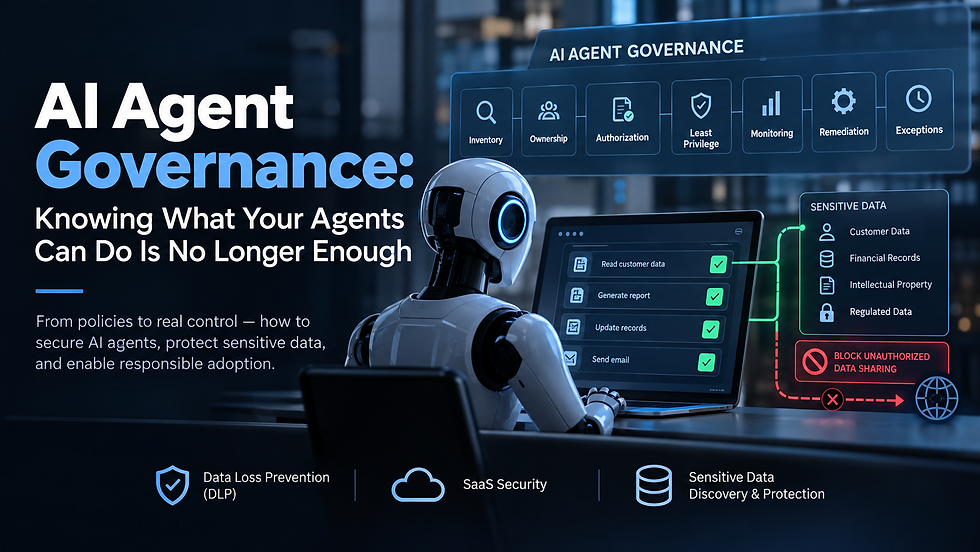
Traditional AI governance policies were largely developed around systems that respond to requests and generate recommendations. Agentic AI introduces another dimension: systems that can independently decide what actions to take and which tools to use.
The governance question is no longer simply whether an AI system is producing accurate results. It is whether the organization knows what its agents are doing, what authority they have, and what information they can access.
From AI Policies to Operational Governance
A recent article by Strac, a company specializing in Data Loss Prevention (DLP), SaaS security, and sensitive data protection, makes an important distinction between traditional AI governance and operational AI agent governance.
An AI policy is not the same as controlling AI agents.
An organization may approve a particular AI platform while having limited visibility into the agents operating within it. Those agents might access confidential financial information, customer records, intellectual property, or other regulated data.
Strac identifies seven essential components of an effective AI agent governance program:
Inventory: Identify every AI agent operating across the enterprise, including unapproved agents.
Ownership: Assign a responsible business or technical owner to each agent.
Authorization: Define which agents are approved and what information they may access.
Least privilege: Limit permissions to what the agent needs for its assigned responsibilities.
Continuous monitoring: Record what agents actually do, not simply what they are permitted to do.
Remediation: Establish procedures to correct inappropriate behavior, revoke access, and contain incidents.
Exception management: Document approved exceptions with clear ownership and expiration dates.
These controls must operate continuously, not simply during initial deployment.
Why Data Loss Prevention Becomes Critical
Consider an AI agent authorized to retrieve customer account information and prepare financial reports.
The agent may legitimately access sensitive data. However, a malicious instruction embedded in a document could cause it to transmit that information to an unauthorized destination.
Traditional access controls might not prevent the incident because the agent already possesses the necessary permissions.
This is where Data Loss Prevention becomes particularly important.
DLP controls can help identify sensitive information, monitor its movement, and prevent unauthorized disclosure. Combined with AI agent monitoring, they provide another layer of protection against data leakage, prompt injection, and unintended information sharing.
Strac's approach matters because it connects agent identities, access permissions, observed activities, and sensitive data classifications.
Knowing that an agent can access sensitive information is useful. Knowing whether it actually accessed or disclosed that information is essential.
Governance Must Be Measurable
Effective governance also requires evidence.
Organizations should be able to answer several fundamental questions:
How many AI agents are operating within the organization?
Who is accountable for each agent?
Which agents can access sensitive or regulated information?
What actions have those agents performed?
How quickly can the organization correct inappropriate access or behavior?
These questions should translate into measurable Key Performance Indicators (KPIs) and Key Risk Indicators (KRIs).
For example, the percentage of agents with assigned owners is a useful governance KPI. The number of unauthorized agents with access to sensitive information is a meaningful KRI.
Without this visibility, management may believe it has established adequate controls while significant risks remain undetected.
Aligning Agent Governance With Established Frameworks
Organizations do not need to abandon established governance frameworks to address agentic AI.
The NIST AI Risk Management Framework provides a foundation through its Govern, Map, Measure, and Manage functions. ISO/IEC 42001 supports accountability, risk management, monitoring, and continual improvement through an AI management system.
However, organizations must translate these principles into controls specifically addressing agent autonomy, identity, permissions, data access, and runtime behavior.
An AI agent should not receive unrestricted authority simply because the underlying technology has been approved.
The Business Case for Better Governance
Strong AI agent governance is not intended to slow AI adoption.
It should make responsible adoption easier by setting clear operating boundaries, assigning accountability, protecting sensitive information, and providing evidence that controls work.
For CIOs, CISOs, and business leaders, the practical starting point is straightforward: identify the agents already operating, determine what they can access, assign ownership, and establish monitoring before expanding their authority.
The objective is not to eliminate risk entirely. It is to understand, measure, and manage risk in proportion to the business value being delivered.
The real test of AI governance is not whether an organization has an approved policy. It is whether management can demonstrate that its AI agents are operating within approved boundaries.
As AI agents become more autonomous, that distinction will matter more.
Reference: Strac — AI Agent Governance: The Operating Model for Agents That Act (2026). Strac specializes in Data Loss Prevention (DLP), SaaS security, and sensitive data discovery and protection, with capabilities addressing AI agents and their access to enterprise information.


Comments